First a Celtic, then a Roman, then a Slavic settlement, and then administered by the Turks, Vidin is dominated by the Danube. The square is new and perfectly typical for the Socialist Realism period. At its centre lies a monument dedicated to the soldiers of the 3rd Vidin regiment, who perished in the Second World War.
Città di Castello is found in an ancient Umbrian settlement, on the fertile banks of the Tiber. The town, maintaining a large part of the buildings raised during its period of flourishing, is unusual in that it has two central squares. Equally important throughout its entire history, Piazza Gabriotti and Piazza Matteotti, once called Piazza delle Donne and Piazza Vitelli, were known by the locals as Upper Square and Lower Square. The cathedral, found in Lower Square, has a cylindrical campanile and bears the name of a local bishop, San Florido, who was sanctified and seen as a protector of the town. In the 6th century, San Florido supported the rebuilding of the settlement after the destruction by the Ostrogoths. The City Hall building dates from the 14th century and is the work of Angelo da Orvieto, who built the Palazzo del Podestà in the neighbouring square. The Torre civica is the symbol of communal power.
It seems the Roman forum once stood on the site of Plaza del Mercado, which became the centre of the community at the end of the 11th century when the region was repopulated. In the Middle Ages, it used to be a plaza porticada, a square bordered by columns, with a weekly fair, as well as corridas and religious ceremonies. The square was the site of royal receptions but also beheadings. In the 15th century, in front of the San Juan church, in the presence of Torquemada, converted Jews were burnt at the stake. Plaza del Mercado Chico is an interesting case representing the fight between secular and religious power. The existence of the San Juan church on the southern side of the square resulted in the church claiming half of it. In the end, the city council voted for building a regular square in 1770. The construction was slow going, only finalised in 1870, with a line of columns masking San Juan, and transforming Plaza del Mercado Chico into a City Hall square.
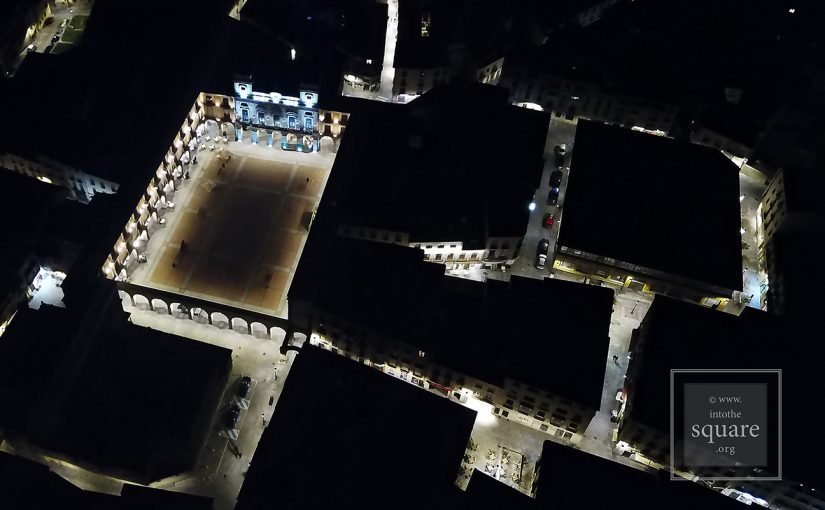
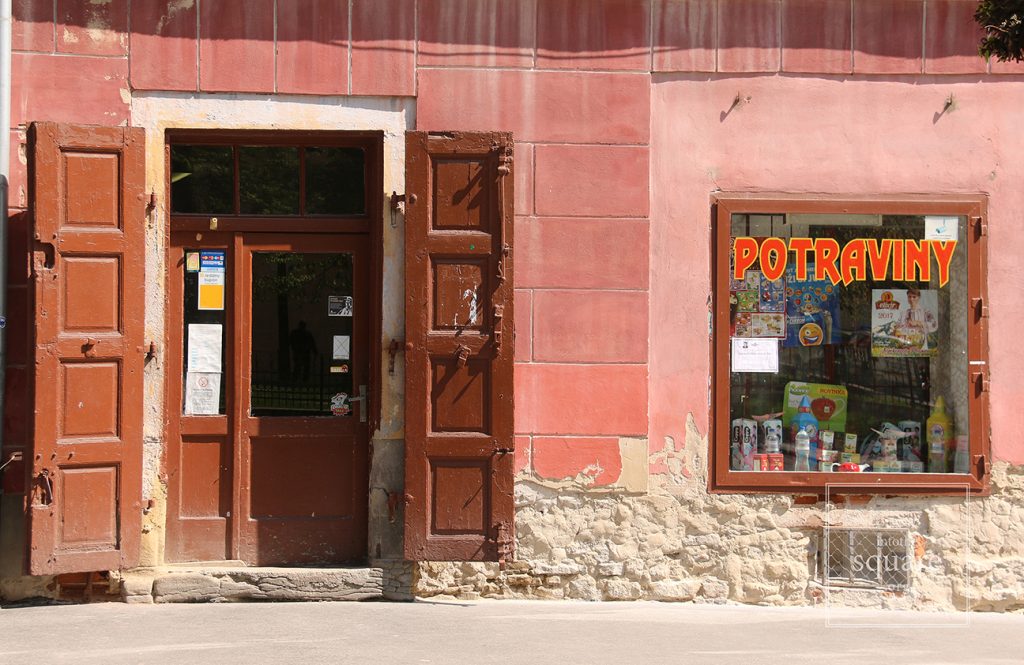
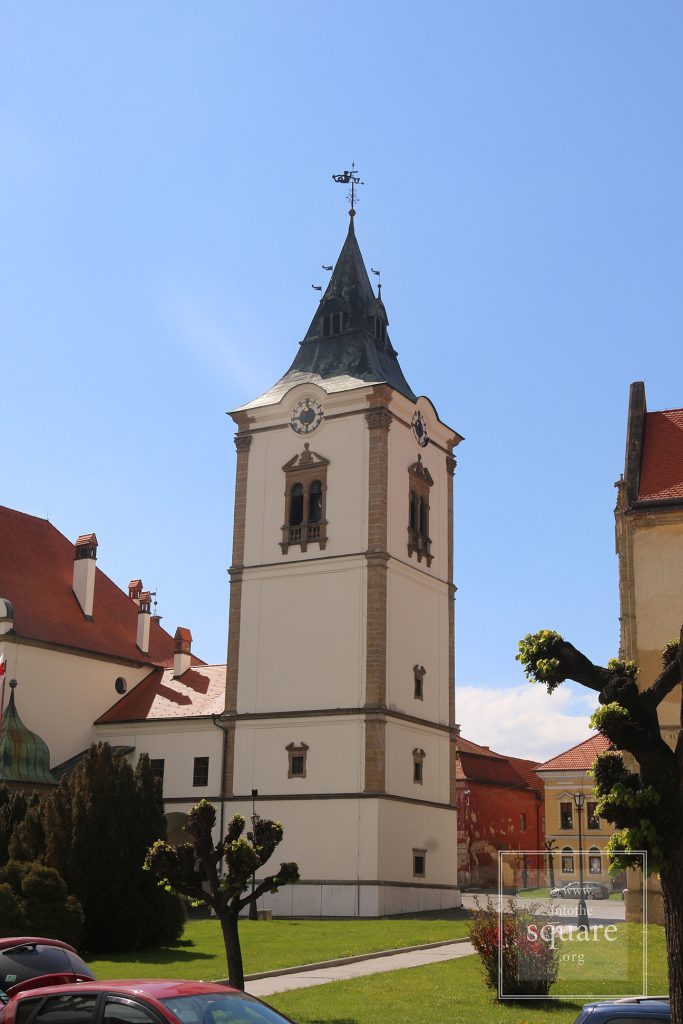
Levoča, called Leutschau in German and Lőcse in Hungarian, was the capital of the historical region of Spiš and features one of the largest squares in Central Europe. It is almost unchanged, with only one or two modern intrusions, bounded by 50 old houses, a few of them with painted façades. At the centre of the rectangular square, which reproduces on a smaller scale the proportions and shape of the still walled burg, one finds the church of Saint Jacob, with the highest wooden carved altar in the world. Made in the late Gothic style, this is the work of a talented and mysterious craftsman named Paul, of whom almost all information was lost during the fire which destroyed the town’s archives in 1550. But the square nonetheless bears his name today. The Majstra Pavla Square also holds the building of the City Hall and its arches, remade after the fire in 1550, one of the best examples of Renaissance lay architecture in Slovakia. Aside from this one finds the 16th century cage of shame, where the guilty were locked up in order to be displayed before the community.
This is one of the most important squares in Bucharest, with a shape influenced by Haussmann’s model of grand intersections. At the end of the 15th century, this was located at the edge of the city, but today it often plays the role of Bucharest’s central square, and, in recent history, it has been the scene of many great public demonstrations. This is where the first school of higher studies in Wallachia originally stood, the Saint Sava Academy, upon which the University of Bucharest was later built in the mid-19th century. The square holds four statues of important figures of Romanian history and there are plans for remaking one other statue, which had been destroyed at the beginning of the Communist period.
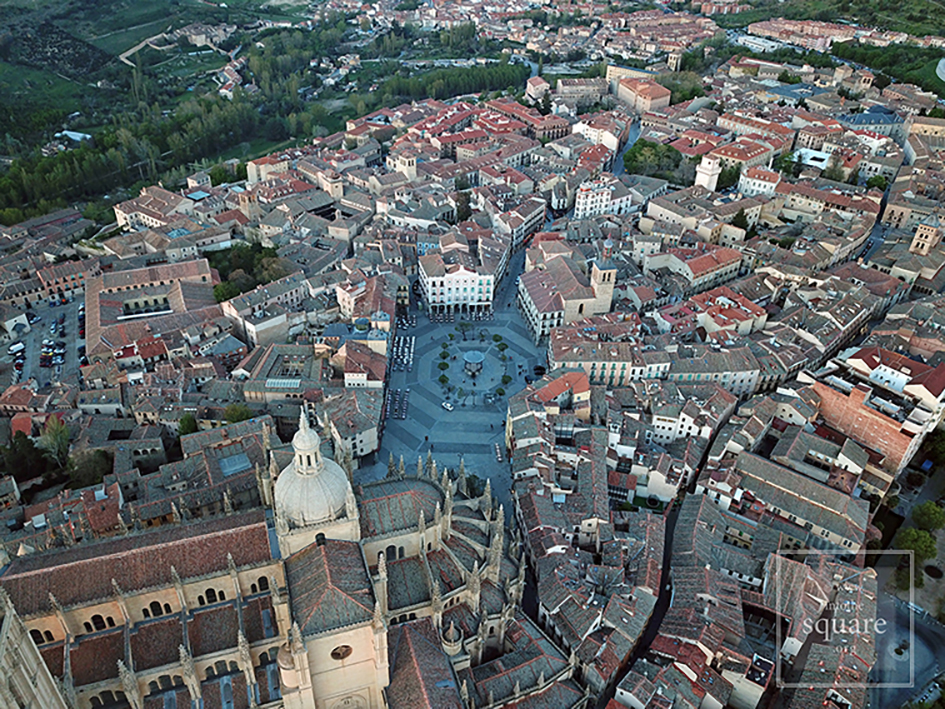
Segovia’s Plaza Mayor has a special meaning for the history of Spain. In 1474, when it was still called San Miguel Plaza, the Catholic Queen Isabella of Castile was crowned there. Otherwise, it is a typical Spanish square. Nonetheless, in an urbanistic sense, it offers an unexpected yet at the same time visually interesting performance. A massive cathedral building, one of the latest Gothic cathedrals in Europe, is found on one of the square’s sides. But Plaza Mayor manages not to let itself dominated by this cathedral. Seen from the square, the cathedral does not appear so monumental, and the square maintains an intimate air, relatable to human height.
Kroměříž is first mentioned in 1110. It has a large square, whose focal point is a baroque-style column raised in the middle in order to mark the end of the plague epidemic in 1680. Next to it there is a fountain, part of the town’s water supply, dating from 1665 yet modified several times. The City Hall building and a long row of Renaissance style houses and Art Nouveau façades border the square; yet the bishop’s palace, with its large, splendid gardens, included on the UNESCO heritage list, is clearly the most impressive of all.
La ciudad conserva restos de las sucesivas murallas que rodeaban el centro y que fueron demolidas durante el siglo XV, visibles ahora por las “muurhuizen”, casas-muralla, hechas con adobe. Fuera de la ciudad vieja, se han desarrollado suburbios lineales a lo largo de las vías principales. Con el tiempo, el espacio entre éstas y la ciudad se ha llenado y la ciudad se extendió posteriormente más allá, pasando la autovía. Su centro sigue siendo la plaza Marktplein de Hof.
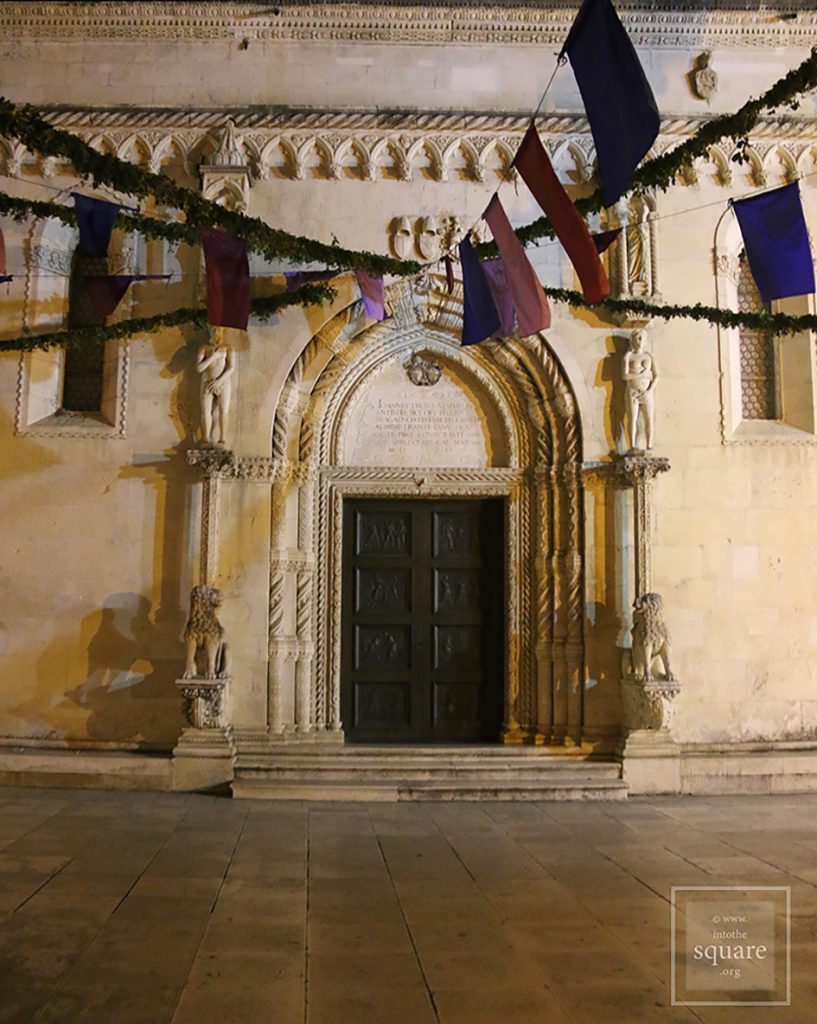
Šibenik is no exception among the towns on the Dalmatian coast. It did not originate as a Greek colony, nor was it founded by Illyrians or Romans, but by the first Croats to settle here. Yet its later history is not very different from that of other coastal towns, impacted by the arrival of the Ottomans, the Venetians, the Kings of Hungary and the Habsburgs. But the Slavs always remain the dominant element in the citadel. For a time, the Istro-Romanian community was numerous here.
The square has distinct nuances and is considered the most beautiful in present-day Croatia. It contains two sections, one of which was the church square, whereas the other was the centre of secular power and, although close to the shore, it was never a port. The important landmarks of the square are the Renaissance-style palace, and especially the Church of St. Jacob, which is part of the UNESCO list.
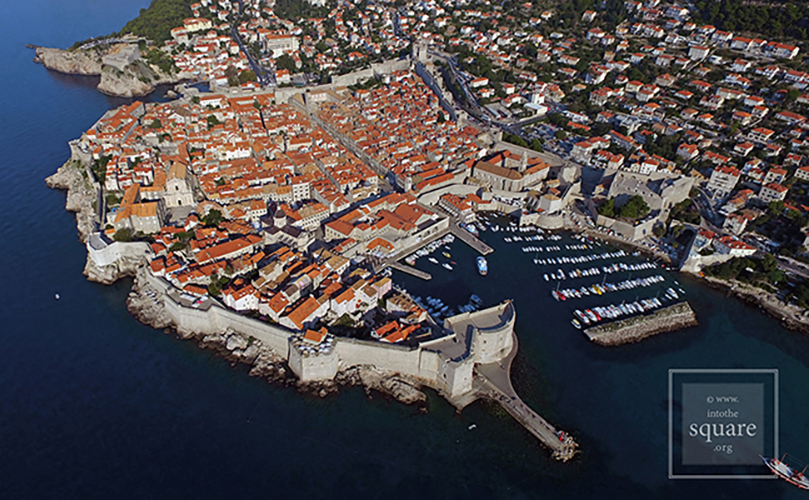
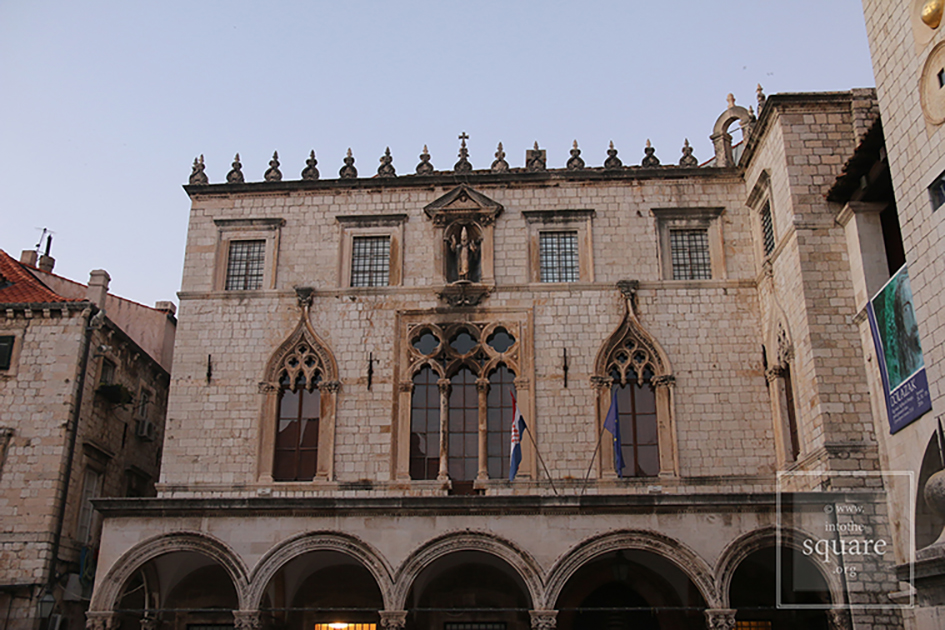
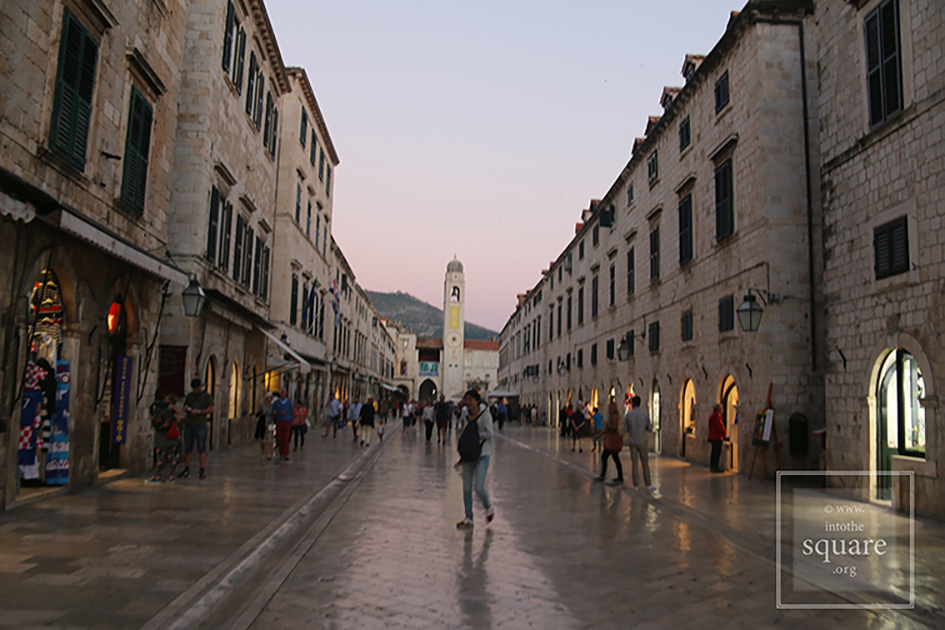
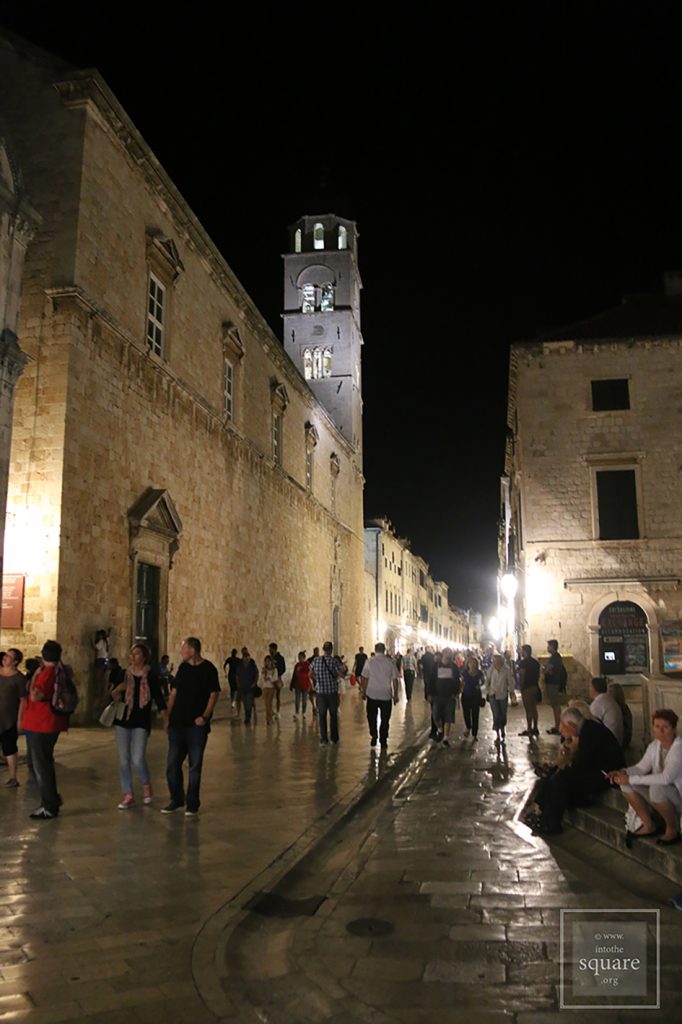
Trg Luža, la gran plaza de Dubrovnik, se encuentra al final de la arteria más ancha que cruza los límites urbanos de oeste a este, llamada Stradun o Placa. Cada extremo representa un punto de entrada a la ciudad, marcado por una puerta y una plaza. Esta estructura, claramente visible en fotografía aérea, está relacionada con el nacimiento de la ciudad. Diez siglos atrás, Stradun era un canal que separaba la antigua colonia greco-romana de Ragusa, ubicada en una isla, del asentamiento eslavo en el continente, Dubrva. En el siglo XI, el canal se colmata y las dos comunidades se unen, aunque la rivalidad y el desprecio mutuo nunca cesarán. Un siglo después estarán dentro de las mismas murallas. Siguiendo el esquema clásico del proceso de sinocismo, la plaza principal se configura en el punto de contacto geográfico de las dos comunidades. Así nació Trg Luža y aquí se construirán a lo largo de su historia los edificios más importantes: la catedral, la estatua de Orlando, el Palacio del Rector, el Palacio Sponza, la Torre del Reloj y la pequeña fuente de Onufry. La calle de la fuente une la plaza Luža con la plaza Gundulićeva Poljana, mucho más tardía, construida después del terremoto de 1667. Las dos, aunque pensadas por separado, forman sin embargo un sistema de conjunto muy interesante y destacable.
Assisi,famous due to Saint Francis, is, through its positioning, yet another exception to the rule of Etruscan settlements. It lies not on a hill, but on a steep side of Mount Subasio. It also holds its own “secrets”. For one, its shape, irregular like any medieval square, represents the shape of the town in miniature. A coincidence, yet a profoundly symbolic one in the town of Saint Francis. Then, it has a special continuity, for it stands on the site of a Roman cistern. The temple of Minerva also dates from the Roman period, converted into a church in 1539 and admired for its proportions by architects and by Goethe as well. Although not planned this way, the buildings are all nearly the same height, which creates the sensation of unity. There is a single exception, the medieval tower next to the temple of Minerva, which makes the square visible from any corner of the town.
San Marco Square lies at the edge of the largest and lowest island in the Venetian lagoon and is the only square in the city which is called piazza, with all the others being called campo. It has two distinct zones, yet their function may not be understood without considering the whole, which actually makes them inseparable: the square itself and the San Marco plaza, which connects to the sea through the molo, the pier. Piațeta dei Leoncini, with a side marked by the northern wall of the Basilica, opposite to San Marco square, has functioned (and still does) as a continuation of the square itself, and thus has a less palpable identity. It received its name quite late, after statues of lions, sculpted from red Cottanello marble, were brought into its centre in 1722. The initial nucleus is essentially represented by San Marco plaza, initially planned as a square and courtyard of the Doge’s Palace in a time when the spot of the current Basilica was taken only by a palace chapel. The space of the square itself appeared only after the 1156 clogging of a river which cut the actual perimeter in two, and the square became a Square only after Venice underwent a number of historical changes, the steps of a communal psychological transformation. Today it is probably the most photographed square in the world, with over 12 million tourists every year.
The history of Aristotelous square began with a fire that destroyed two thirds of the city in 1917. Until that point – due to centuries of Ottoman rule – Thessaloniki was an Oriental city, with no square. Moreover, any attempt to design one had been thwarted by the impossibility of demolishing an area which had been built too densely. However, what cannot be achieved by architects can be accomplished by fire. The project was prepared by Frenchman Ernest Hébrard in 1918, but finalised only in 1950.
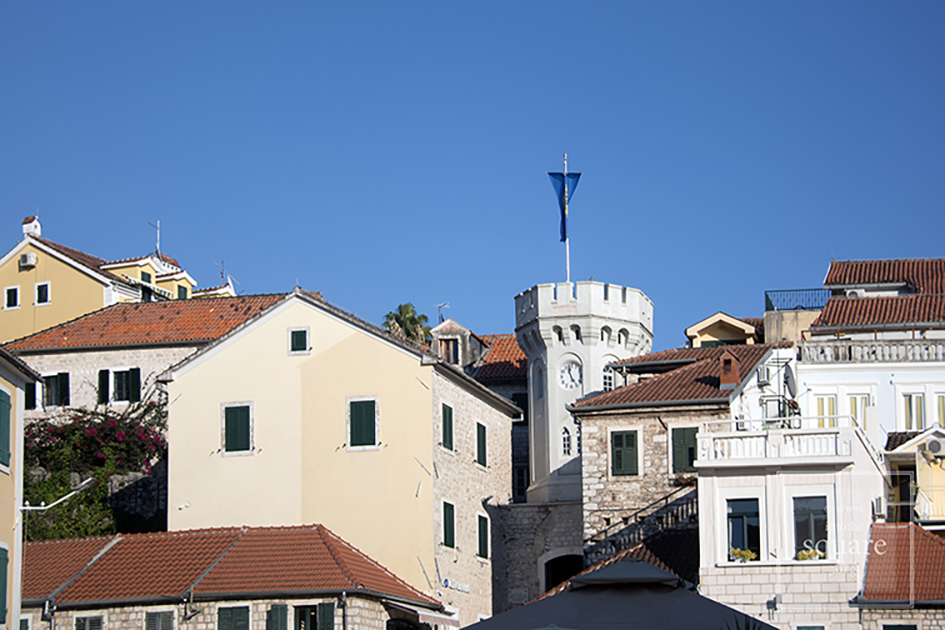
Herceg Novi (Castelnuovo in Italian) is not new as the name claims, but rather quite old, for it was founded in 1382 on the site of a fishing village by the Bosnian King Stephen I, which is also the name of this town’s central square. The Turks conquered the town in 1482 and remained there for two centuries, with a brief Spanish interlude. The town came under Venetian rule in 1687, then passed to Austro-Hungary. After that, Herceg Novi was temporarily ruled by Napoleon, the Russians, and Mussolini, and then became part of Yugoslavia. Its history, though not in its entirety, can be found in its square. It is paradoxical square, for it was built in a typically Italian style, with a splendid Orthodox church in the middle, surrounded by palm trees. Unofficially, the name of the square is Belavista. From there the sea is visible, as well as an Ottoman clock tower, a Spanish fortress, the bell tower of the Catholic church and the lower part of the city.