Tartinijev trg from Piran, Slovenia

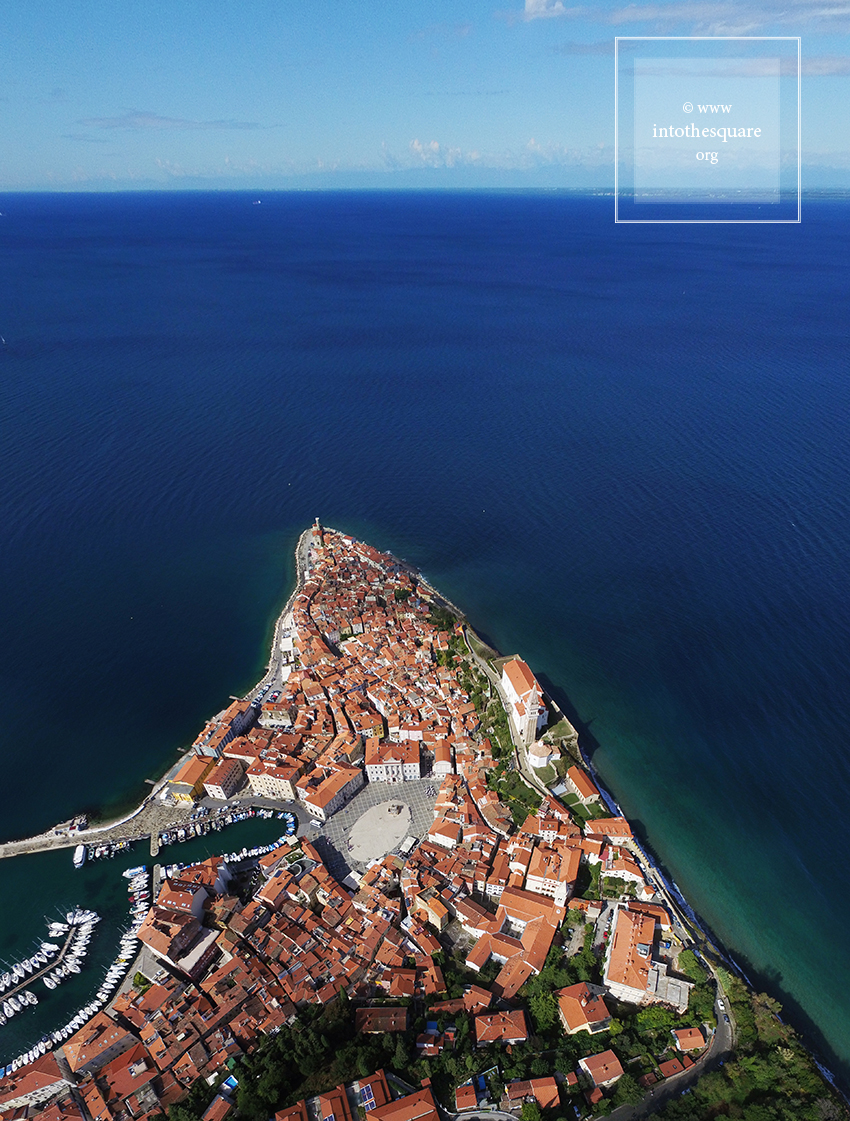
Giuseppe Tartini, author of the well known Il trillo del diavolo, was born in this city, then called Pirano, part of the Republic of Venice. The Piran square bears his name, and the birthplace of the composer can be found on one side of the square. At the time of his birth, however, the place looked completely different. Rather than a square, this area was first a loading dock for fishing boats coming in from the Adriatic, found outside the citadel walls . In time, palaces and beautiful administrative buildings were built closer to the piers. By 1894, the importance of the place grew enough that the authorities decided to silt the gulf and build a true square. Two years later, Tartini’s statue is unveiled, thought of as a focal point, and the square, dominated from the hill by the Saint George church and with a campanile identical to the one in Venice, is a harmonious and lively space, with a proper and accomplished balance of form and proportion.


DCIM100MEDIADJI_0032.JPG

Prešernov trg & Mestni trg from Ljubljana, Slovenia

Prešernov trg was a simple crossroads at the entrance to the medieval city, where, in 1646, a Franciscan monastery was built and remains to this day. In the 19th century, the crossroads was paved and started to resemble an urban square. The end of the same century brought about a radical transformation, as an earthquake in 1895 resulted in the old houses being replaced by Neoclassical and, later, Sezession style buildings. In 1980, the Slovenian architect Edvard Ravnikar created the current circle design of its pavement, which lends a special note to the square: a sun, on a granite background, with rays made of Macedonian Prilep marble. A triple bridge, Tromostovje, across the Ljubljanica, ties the square through Stritarjeva ulica to the old square of the city, found at the foot of the hill where the castle is, next to the cathedral. The city square, Mestni trg, is dominated by a fountain built in 1751. The two squares, although they were not planned together, as each was partly the result of later redevelopments, represent an unexpectedly coherent and suggestive urban whole.

Náměstí Zachariáše z Hradce from Telč, Czech Republic

Founded in 1354, in a thick forest, on the spot where two roads crossed next to waterways at the border between Moravia, Bohemia and Austria, Telč (or Teltsch in German), had the misfortune of experiencing a great fire two centuries later. The city was quickly rebuilt following the original plan, but with modifications which took into account the evolution of building styles and techniques. The Gothic castle was remade in the Renaissance style and lofts were built for the houses in the square. The houses received painted façades, which were later replaced in the 18th century with rococo and baroque ones. The medieval Gothic arch on the ground floor remained unchanged. It is continuous, uniting all the houses in the square. Two churches were built and a plague column was dedicated to Saint John Nepomuk, flanked by two fountains. Towards the end of the 18thcentury, time suddenly stopped in Telč, with the end of its age of glory and economic development. The city reached our times without further changes, unaffected by industrialisation and, through some miracle, without socialist blocks. It is straight out of a book of folk tales. The map of the city is practically synonymous with the triangular square. One step outside of it carries you to the yellow canola fields of the Bohemian hills.

Náměstí from Štramberk, Czech Republic

Similar to many other small, out-of-the-way places, this square is simply called “Square,” or Náměstí in Czech. Štramberk is yet another example of a place where the entire town is condensed into its square. Aside from the row of houses that line its perimeter, only two or three additional streets complete the map. Trúba, a cylindrical tower consisting of the remains of a castle about which few things are known, dominates this settlement, perched on a nearby wooded hillside. Everything here reminds one of a fairy tale, from the forests to the castle to the square. A large number of wooden houses from the 18th and 19th centuries also add to the local cultural heritage. The land where Štramberk is located is called Valašsko, from the name of the populace who migrated here in waves, along the Carpathians from Transylvania and, perhaps, from Bukovina. Though the language of the Vlachs was lost along the way, and these people were slavicised, some customs did survive, such as the traditional building techniques that were adapted by local Czech and German craftsmen. The wooden houses clearly bring to mind the wooden Romanian architecture from Transylvania. A number of local settlements had such centres, but the wooden houses have been replaced by stone ones, usually Baroque in style. Štramberk has the greatest number of Vlach-style wooden houses, as they are called here, creating an interesting architectural reservation. Its square is also linked to the preparation of local cakes called “Štramberk ears,” which legally can only be made here. It is said that they have this name because the people of medieval Štramberk thought they resembled the ears of captured Tatar soldiers, during the time of the Tatar raids.