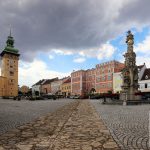
Třeboň, or Wittingau in German, has one of the best-preserved medieval squares in Bohemia. In fact, only its shape dates from medieval times, since its current form, with its Renaissance and Baroque houses, resulted from the flourishing fish trade of the 14th century. Beginning in the mid-14th century, the natural landscapes around the city were gradually transformed by human intervention. The marshlands gave way to a dense network of over 500 lakes, grouped into 16 aquatic systems, today a paradise returned to the wilderness and populated with rare species of plants and animals. The largest of these lakes is located right near the city and is tied to the Rosenberg family, owners of the medieval burg. Like all historical cities in Bohemia and Moravia, this square contains a plague column; a Renaissance fountain; and a tower building belonging to the City Hall.
Bir çox digər kiçik, yol kənarında yerləşən məkanlar kimi bu yer də Çex dilində sadəcə Meydan, yəni Namesti adlanır. Ştramberk şəhəri bütün şəhərin öz meydanında sıxlaşdığı bir yerin başqa bir nümunəsidir. Perimetrini müəyyənləşdirən sıra evlərdən başqa, əlavə olaraq yalnız iki və ya üç küçə onun xəritəsini tamamlayır. Qalanın haqqında az şey bilinən qalıqlarından ibarət, yaxınlıqdakı meşəli bir təpə üzərində pərçimlənmiş Truba adlanan bir silindrik qüllə bu qəsəbəyə hakimlik edir. Buradakı hər şey meşələrdən meydandakı qalaya qədər bir nağılı xatırladır. Mədəni irsinə XVIII və XIX əsrlərdən qalma çox sayda taxta evlər də əlavə edilmişdir. Ştramberkin yerləşdiyi ərazi Karpat bölgəsi boyunca Transilvaniyadan və bəlkə də Bukovinadan ardıcıl bir neçə dalğada buraya köçən əhalinin adından ilhamlanaraq Valassko adlanır. Vlaxların dili illər keçdikcə itirilsə də və bu insanlar slavyanlaşsa da, yerli çex və alman sənətkarlarının burada adaptə etdikləri ənənəvi inşaat texnikaları kimi bəzi adətlər yaşamışdır. Taxta evlər Transilvaniya mənşəli Rumıniya taxta memarlığını açıq şəkildə biruzə edir. Bir neçə yerli qəsəbələr bu cür mərkəzlərə malik idi, ancaq taxtadan hazırlanmış evləri hazırda əsasən barok üslublu daş evlərlə əvəz olunub. Ştramberkdə böyük sayda vlax stilli taxta evlər vardır ki, indi də onlar bu cür adlandırılır və maraqlı bir memarlıq qoruğu yaratmaqdadır. Meydan həmçinin, qanunla yalnız burada hazırlana bilən “Ştramberk qulaqları” adlanan yerli tortlarının istehsalı ilə tanınır. Deyilənlərə görə, bu tortlara bu ad ona görə verilib ki, orta əsrlərdəki Ştramberk sakinləri düşünürdülər ki, hazırlanan tortlar tatar basqınları zamanı əsir götürülən tatar əsgərlərinin qulağını xatırladır.
In 1278, count Berthold von Rabenswal receives from Emperor Rudolph I von Habsburg the right of ownership over the Hardegg land. He begins at once the building of a new settlement next to an existing village, called Rezze. He will follow a regular plan, in the style of Bohemian burgs, around a square that remains to this day among the largest in Austria, although the current population of the settlement numbers only 4000 people. The square is beautiful, with Italian inspired Renaissance palaces, fountains and a Baroque column of the Holy Trinity. In the middle stands the city hall, a former church, repurposed in 1569. But the bigger surprise lies beneath the pavement: under the square, under the entire town and even beyond lies a labyrinth of interconnected cellars, where the inhabitants have deposited local wine. It is over 20 km long, far greater than the network of streets above.
Todi has three rows of fortified precincts. Following them towards the town’s interior, one climbs towards its square and descends into history, crossing medieval Roman and Etruscan walls. The square stands on the site of an old Roman forum, just as the Cathedral, which lies at the edge of the square and some steep steps, stands on the site of a temple to Jupiter. The Piazza del Popolo of Todi, a closed space dominated by massive crenellated buildings, conveys, along with its fortifications, a strong sense of protection. It is often cited in historical studies as the most convincing example of a medieval square. It is certainly beautiful and impressive. In the neighbouring Garibaldi Square, one crosses through a narrow passage that offers an unexpected surprise when it comes to the structure of the town. It shows the exact opposite: a side that is entirely open to the Umbrian hills.