Split, Hırvatistan, Trg Peristil

Eski Split kente yukarıdan bakıldığında, birinin bina, sokak ve meydanlar yerleştirdiği dikdörtgen bir kutu gibi görünüyor. Split’teki meydanların en ilginç ve en eskisi, Trg Peristil’tir ve yerel halk tarafından yerin tarihi kalbi olarak sayılmaktadır. Meydanın tarihi, oldukça özeldir. Başlarda meydan, 305 yılında Roma İmparatoru Diocletian için inşa edilen, 300 metrekarelik devasa bir alanı olan sarayın iç avlusuydu. Aslında, eski Split kentin yarısı sarayın surları içinde yer almaktadır ve günümüze kadar en iyi korunmuş Roma sarayıdır. Romalılar onu terk ettikten sonra, Slavlardan korunmak amacıyla Salona sakinleri duvarlar arasına yerleşip eski sarayı şehre dönüştürene kadar yüzyıllarca terkedilmiş şekilde kalmıştır. Daha sonra hep şehir olarak kalacaktır. Mekanın ilk başpiskoposu olan Ravenna, Diocletian’ın mozolisini bir kiliseye dönüştürmeye karar verir. O andan itibaren saray avlusu, bir ortaçağ meydanın tüm işlevleriyle birlikte, resmi olarak katedralin meydanı haline gelmektedir. Dönüşümlere uğrar, ancak kırmızı porfir sütunları da dahil olmak üzere, bir takım parçaları korunur.

Hlavné námestie from Košice, Slovakia

Hlavné námestie means Great Square in Slovak, but the early history of this city and its central square is tied to the German colonists who arrived here in the mid-13th century, at the invitation of King Béla IV of Hungary. The city of Košice (Kaschau in German, Kassa in Hungarian, and Cașovia in the old Romanian chronicles), existed at the crossroads of great trade routes linking the Baltic Sea with the Black Sea; Poland with Transylvania; the east of Europe with the south of Europe. Its urban space is rigorously structured. Three parallel roads run from north to south, with the middle road becoming progressively wider until it meets the main east-west artery, forming a special, lens-shaped square. The lens shape is due to the construction of the square in a region that formerly functioned as a trade fair. The trade fair took place in a widened section of the road, halfway between a castle and an abbey, before any other buildings were constructed. The shape also comes from the unification, through a typical process of a synoecism, of two distinct pre-13th century settlements, whose borders were those of the present-day square. At its centre, where these two axes intersect, the German colonists erected a parish church. In the 14th century this church was replaced by the Gothic Cathedral of Saint Elisabeth, the largest Cathedral in Slovakia to this day. The tower of Saint Urban, containing a seven tonne bell, and the Chapel of Saint Michael, both Gothic and built in the 14th century, flank the Cathedral, creating a unique and unitary whole. The theatre, a Neo-Baroque jewel, was finalised in 1899. Gothic houses, Renaissance and Baroque palaces, and Art Nouveau buildings define the perimeter of the square. The contours of the old city walls are clearly visible along the circular paths of the adjacent streets. The lens-shaped square of Košice is the largest and most coherent urban ensemble of its kind, typical of eastern Slovakia.

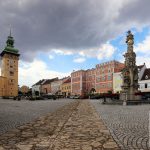
Hauptplatz from Retz, Austria

In 1278, count Berthold von Rabenswal receives from Emperor Rudolph I von Habsburg the right of ownership over the Hardegg land. He begins at once the building of a new settlement next to an existing village, called Rezze. He will follow a regular plan, in the style of Bohemian burgs, around a square that remains to this day among the largest in Austria, although the current population of the settlement numbers only 4000 people. The square is beautiful, with Italian inspired Renaissance palaces, fountains and a Baroque column of the Holy Trinity. In the middle stands the city hall, a former church, repurposed in 1569. But the bigger surprise lies beneath the pavement: under the square, under the entire town and even beyond lies a labyrinth of interconnected cellars, where the inhabitants have deposited local wine. It is over 20 km long, far greater than the network of streets above.