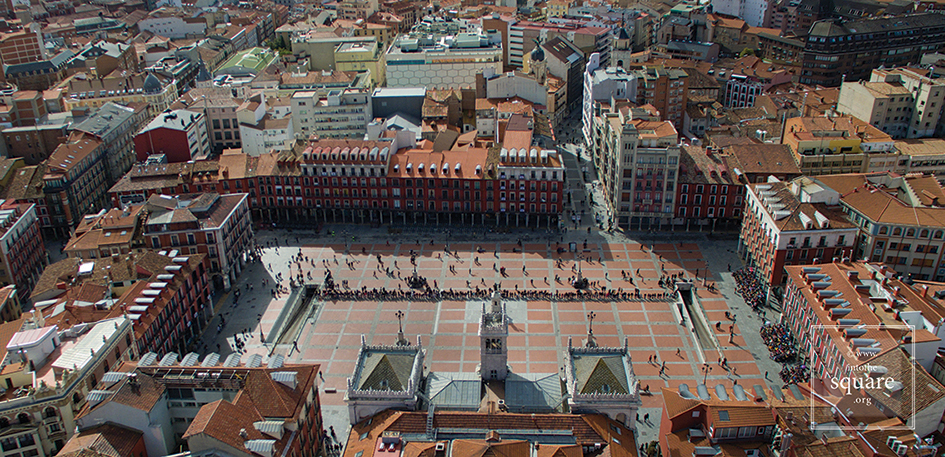
This is one of the largest squares in Spain and lies right at the entrance of the medieval town. Its origins are found in the 11thcentury, when the space was used for the great traditional holidays. The buildings are from different eras, with all of them having a 16th century ground floor colonnade. On the northwestern side, the Bujaco Tower is an eye-catching building, now a symbol of city. It was built during the Arab rule, on top of Roman foundations. The origins of its name may come from the local word for straw dolls, bujacos.
Per le città europee la piazza è il luogo più significativo. È lì che convergono le vie più importanti e che si trovano gli edifici e le statue più rappresentative. La piazza di una città europea è un riassunto: storico, architettonico, culturale, sociale. Nella piazza di una città si rivelano spesso simultaneamente tutti gli strati della vita umana, a livello individuale e sociale. Da questo punto di vista, la piazza è uno spazio privilegiato. Un palinsesto che parla, se lo si sa interpretare, delle varie epoche della storia e della vita di quell’insediamento.
La storia delle piazze europee è legata con un filo storico continuo all’Antichità greca, dove appare prima la plateia, poi l’agora. La piazza urbana è specifica per l’Europa, le altre culture non ne possiedono una così lunga continuità, sebbene le piazze esistano pure lì, alcune pure molto vaste. L’Europa ha inventato la piazza, l’ha sviluppata come forma architettonica, per esportarla poi nel resto del mondo, soprattutto nel periodo coloniale.
Πορεκ, Κροατία
Mentre inizialmente si presentava come un mero ampliamento della via principale delle polis greche, col tempo la piazza acquista compiti comunitari e religiosi e comincia ad essere abbellita. Dai greci passa agli architetti romani, che rendono il foro essenziale nel pensare lo spazio. Dopo la caduta dell’Impero romano, la vita urbana ritorna in Europa appena intorno all’anno 900, quando molti dei borghi medievali si sviluppano sugli insediamenti romani, conservando la loro planimetria e struttura stradale, dove al posto del foro subentra la piazza centrale, come avviene a Zdar o Poreč sulla costiera dalmata.Se fotografata dal drone, qualsiasi città medievale rivela la fondamentale opposizione tra il margine e il centro, perché le città medievali sono sempre circondate dalle mura. Alcune, come Óbidos in Portogallo, conservano intatte al giorno d’oggi queste fortificazioni. La piazza è uno spazio ampio, che si oppone come volumetria alle strade sempre strette e tortuose delle città. È quasi d’obbligo che nella piazza centrale si trovino la cattedrale e una fontana. Nel caso delle città piccole, la fontana ha anche un ruolo funzionale. Nel caso di quelle grandi, il ruolo è uno meramente estetico: la presenza della fontana è un riflesso della tradizione, del costume.
Όμπιδος, Πορτογαλία
L’esistenza delle mura ha generato delle conseguenze significative per le città di tutta l’Europa occidentale. Prima di tutto, lo spazio limitato ha fatto sì che, per secoli, la popolazione rimanesse numericamente costante all’interno delle mura. Quando la popolazione cresce, è preferibile fondare un nuovo insediamento invece di allargare la cinta muraria. La costruzione inizia sempre dal centro, dalla piazza, quello è il posto che viene stabilito per primo. Una seconda conseguenza importante dell’esistenza delle mura: il centro rimane sempre lo stesso. In questa comunità, la piazza si sovrappone di solito al centro geometrico, che era lo spazio più protetto. Là il nemico arriva per ultimo. Poi, l’accesso in città si fa attraverso alcune porte e, per forza, tutte le strade portano fino alla piazza centrale. La prospettiva aerea mostra come la piazza sia il punto di focalizzazione della città medievale. Le mura segnano nel modo più ovvio il rapporto di opposizione del centro con la periferia. Da qui deriva nel tempo un’altra conseguenza: quando, agli inizi della modernità, le mura vengono abbattute, queste città tendono a svilupparsi non in maniera lineare, bensì concentrica, aggiungendo delle fasce successive ad una struttura preesistente, ancora visibile, d’altronde, in molte delle città europee odierne.
Βαγιαδολίδ, Ισπανία
Nel Rinascimento, l’Europa riceve in eredità le città medievali, alle quali non è più affezionata e che vuole cambiare: nell’ambito di certi limiti costruiti, l’Europa immagina diversi mondi urbani. Questo periodo, tuttavia, non resta nella storia per la costituzione di città reali, quanto per quella di città fittizie. Quando tuttavia la storia pasa dalla teoria alla pratica, ciò avviene piuttosto in seguito a delle calamità. Il 21 settembre 1561, un grande incendio colpisce la città di Valladolid. Quello che per la città è un disastro, è per l’urbanistica una grande opportunità. Nello spazio rimasto vuoto viene costruita la stupenda Plaza Mayor, che resta tutt’ora una delle più grandi di tutta la Spagna. È la prima piazza regolare dell’Europa, oggi ingiustamente misconosciuta come tale. La sua pianta simmetrica si nota benissimo dall’alto. Il modello architettonico e urbanistico istituito a Valladolid viene in seguito ripreso da varie altre piazze e tocca la perfezione nel 1729 con la Plaza Mayor di Salamanca, una delle più belle del mondo. Sempre e solo dall’alto si nota subito che il suo perimetro non è quadrato, ma trapezoidale. All’altezza dello sguardo, chiunque percepisce la piazza con i lati perfettamente paralleli e uguali: una sottile illusione ottica, attentamente calcolata per aumentare la prospettiva e aumentare lo spazio relativamente piccolo che l’architetto ebbe a disposizione.
Σαλαμάνκα, Ισπανία
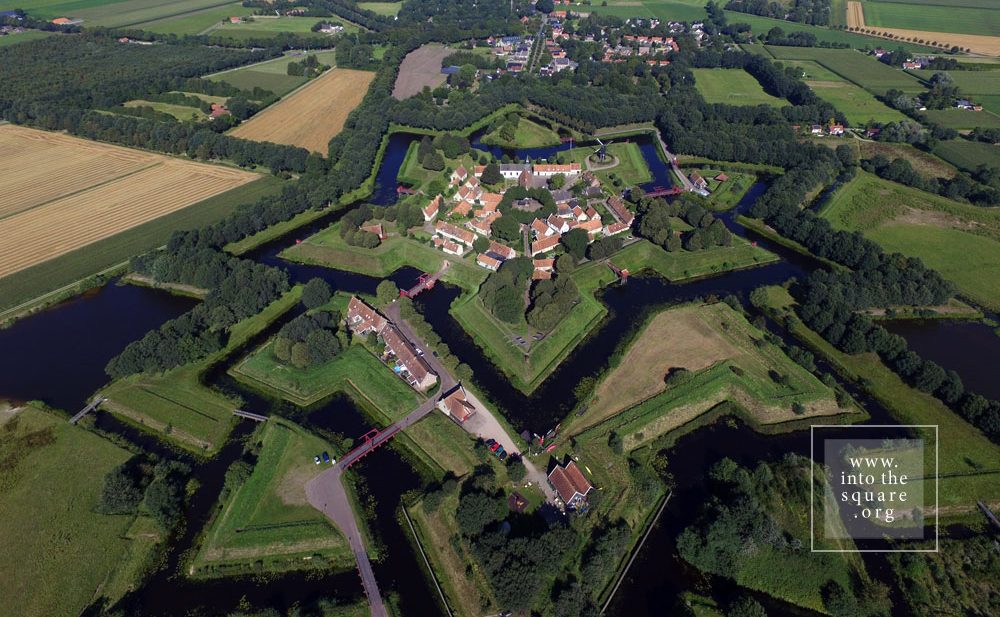
A cominciare dal Cinquecento, le città continuano ad avere le mura di cinta, ma queste vengono pensate diversamente. Sempre di più, il compito di progettare il disegno della città passa dall’artista architetto all’ingegnere. Il momento fondamentale di questo cambiamento viene segnato nel Seicento e collegato al nome di Vauban. Il tipo di fortificazioni che lui propone ha come scopo di far stanziare all’interno della cinta muraria fortificata un grande numero di soldati. I forti a forma di stella si diffondono rapidamente in Europa, da Naarden e Bourtange in Olranda, fino ad Alameida in Portogallo o Alba Carolina in Romania. Queste città militari hanno una struttura perfetta, con vie rette che portano per forza verso una piazza larga, collocata al centro. A livello dello sguardo normale la perfezione dei forti si lascia semmai intuire, anche perché gli edifici sono spesso austeri. Ciò nonostante sono di gran lunga i più belli insediamenti del continente se fotografati dall’alto, come altrettante stelle adagiate per terra. Mai come in questi casi risulta così evidente l’importanza della piazza come spazio centrale.
Νάαρντεν, Ολλανδία
A partire dalla metà del Settecento e lungo l’Ottocento, le città si reinventano in un modo che riflette i cambiamenti militari, tecnologici e politici. L’autorità delle città-stato era già sminuita da un bel po’ di tempo, fino a scomparire completamente di fronte all’autocrazia dei monarchi. Questi aprono l’accesso in città dei soldati, i quali hanno bisogno di vie rette: per un’azione veloce, ma anche per presentare le loro parate. La nobiltà comincia ad abbandonare le residenze fuori città, vuole stare più vicina ai centri del governo e si fa costruire dei palazzi in città. Col tempo questi ne diventano la residenza di base. Indi, molti dei nobili cominciano ad essere interessati a come si presenta la città, sicché i piani di queste cambiano radicalmente. Cambia inevitabilmente il senso delle piazze e il loro rapporto con il resto dello spazio. Laddove gli insediamenti medievali avevano una struttura basata sui bisogni dell’intera comunità, ora le città si modificano per corrispondere al gusto degli aristocratici. Nell’ambito dell’estetica urbana avvengono trasformazioni essenziali. Quando le strade diventano rette, la prospettiva si apre, la gente comincia a vedere a distanza, al di là del primo angolo della strada. Da qui fino al concetto di vista manca solo un passo. La vista, sconosciuta all’Antichità classica, suppone un concetto urbanistico molto più complesso: i monumenti e le statue non vanno viste soltanto da vicino, esse rappresentano un punto di riferimento quando si trovano alla fine di una via lunga e retta che permette all’occhio di penetrare nella piazza anche da lontano. Quello che prima era un effetto scenografico casuale, ora diventa un argomento di studio. Gli archi trionfali, le colonne commemorative, le statue sono costruite e collocate in modo da essere belle anche da lontano. Da qui alle arterie che attraverseranno le città come altrettanti corridoi celebrativi manca solo un passo. Se guardata dall’alto, Lisbona rivela le trasformazioni coordinate dal marchese di Pombal, dopo il devastante terremoto del 1° novembre 1755. Le piazze della città rappresentano un vero e proprio sistema: larghi viali retti collegano la Piazza del Commercio a Rosio, Rosio a Figueira, Martim Moniz a Restauradores, Restauradores a Praça do Marquês de Pombal, e in mezzo a ciascuna di queste troneggia un monumento significativo.
Λισαβόνα, Πορτογαλία
Non bastano gli edifici per far esistere una piazza. Le città sono un amalgama di persone e di edifici e il rapporto fra i due elementi non è tanto chiaro quanto possa sembrare alla prima vista. Le persone costruiscono gli edifici e il modo in cui una comunità sviluppa nello spazio la propria storia, religione, fede di qualsiasi tipo, i bisogni concreti della vita quotidiana non è, ad oggi, molto chiaro: tante sono le sfumature di questo complesso processo che ci sfuggono e forse mai si lasceranno descrivere fino in fondo. Una piazza ha la sua propria architettura ma, allo stesso tempo, rappresenta più della sua architettura. L’intero passato, concatenato in un sistema di rapporti visibile-invisibile con l’immaginario simbolico della collettività, si fa notare nell’esistenza della piazza.
Today this is a village, with 133 houses and fewer than 300 inhabitants. Yet Bourtange was built as a military fort in 1593, during the Dutch Revolt, on the orders of William the Silent. It held this role until 1851, when it officially lost its defensive function and became populated by craftsmen and farmers. Its initial purpose was to guard the road linking Spanish Groningen to Germany. It is one of the most spectacular star-shaped forts in Europe. The pentagonal plan and its network of canals and fortifications respects the original project. The square stands in the geometric middle and follows the pentagonal shape of the buildings placed within the fort. Its perimeter is perfectly defined by 14 lime trees which are over 300 years old. The square holds the most important houses: the captain’s house, the commander’s house, and the house of the school headmaster, for the placement of its buildings was hierarchical. The Protestant church dates from 1869 and, notably, is situated close to the square but not within the square itself.
On the Portuguese side of the border there are even more fortifications than in Spain. Almeida is found in the north of Portugal. It is a star-shaped fort with 12 corners, Vauban style, built in 1641. The Spanish only entered there once in all their history, and then with the help of the French. The square is an irregular quadrilateral and is not positioned quite geometrically, just as the star is not perfect; but its role as a centre is obvious when viewed in relation to the margins of the citadel.
Coimbra is famous for its university, and monumental squares are located in the university area. The city also possesses a small jewel of a square, modest in size but convincing through its balanced proportions and its historical importance. It is Praça 8 de Maio, found in the city centre, in front of the monastery of Santa Cruz, while further on one finds the Câmara Municipal. This small space manages to not be dwarfed by the height and splendour of the Manueline façade of the church where the first two kings of Portugal lie buried. The buildings on the other three sides are just as visible, likewise the central fountain. The contemporary redesigning of the square also contributes to its openness.
At a short distance from the monumental Praça do Comércio stands the municipal square, which hosts three important buildings: the Municipality, the Court of Appeals and the Naval Arsenal. It is a small, quiet square, with different rhythms from the Praça do Comércio, which, following the Rua do Arsenal, stands less than 70 meters ahead. Praça do Municipio is equally part of the urban fabric woven from the city’s reconstruction under the guidance of the Marquise of Pombal. This historical detail is enough to make it clear that they must be understood as counterpoints, that is, as parts of a broader, interconnected system of squares.
This town took its name from Count Rodrigo González Girón. It was he who, in the mid-12th century, banished the Moors from this region once and for all, and built this town on top of a former Roman castrum, itself built atop a Celtic settlement. Its solid fortifications speak to its position on the border with Portugal. Paradoxically, although it is one of the most well-defended European borders on both sides, this frontier was the most stable in all of Europe’s history and has remained this way for 500 years. The only fighting to take place here was against Napoleon’s armies. Nowhere is the relationship between centre and periphery more marked than in such citadels.
The construction of this square began in 1729, by order of Phillip V, with the square primarily intended for bull fights. Today, it is seen as one of the most beautiful squares in Spain and in the whole of Europe. The space offers a paradoxical optical illusion. From the ground it appears to be a perfect quadrangle, but when seen from an aerial photo, the shape is irregular. The baroque façades of the building, which surround and define the square’s perimeter, seem perfectly symmetrical at first glance, but in reality, none of them are the same height. Entire books have been written about this square in Salamanca, and, to this day, it is considered the absolute model of Spanish squares.
Already from the 14th century, markets were constantly held in Piața Sfatului in Brașov and produce was exchanged. Back then it was called Marktplatz. The space is dominated by the Casa Sfatului, constructed in 1420. It not only forms the centre of the square, but also offers an interesting chromatic counterpoint, through its light colour, to the nearby Schwarze Kirche, the Black Church, visible from the square.
This square owes its existence to the great Lisbon earthquake of 1 November 1755 and the fire that followed. On this spot, abandoned due to natural disasters, a new, well-ordered city was built, as a result of reconstruction efforts coordinated by the Marquise of Pombal, the leader of the royal government.
Praça do Comércio was built on Terreiro de Paço, the site where the court of the Royal Palace had previously been held. This name is still used for the square, with its one side facing the Tejo, the greatest river on the Iberian Peninsula. Measuring 175 by 180 meters, this square is one of the largest on the European continent.
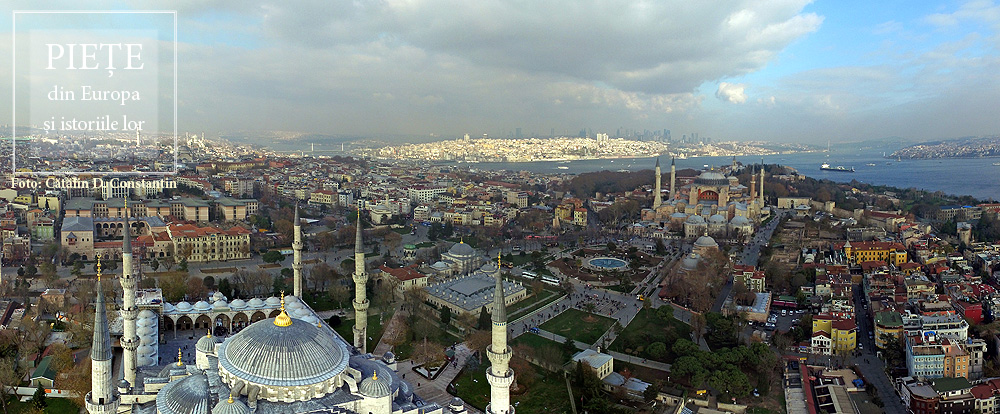
This square bears some of the ambiguity of the meeting point of the Orient and Europe. This is not a single square, but rather two squares brought together and identically named. Between the Hagia Sophia and Sultan Ahmet Camii, known as the Blue Mosque, lies a square with a fountain at its centre, often called Ayasofya Meydani, although the official name is Sultanahmet Meydani. It is a market-garden, built on the spot which held the Augusteion, the Roman forum of Augustus. Paradoxically, the long square between the Blue Mosque and the Museum of Islamic Art keeps the name Sultanahmet Park, although it is less of a park than the neighbouring square. There is no place in the world that brings together so much history. The obelisk of Theodosius the Great is, in fact, Egyptian, and was brought here in 390, from Luxor. Sculpted in Aswan granite, it was built in 1490 B.C. for the Egyptian pharaoh Thutmose III. The serpentine column was brought in 324 to the temple of Apollo at Delphi, where it celebrated the victory of the Greeks against the Persians. Cast from the alloy of the Persian weapons and melted down by the Greeks, it is now 2500 years old. Another obelisk was built in the 10th century by Constantin VII. One must also add the “German fountain” built in 1900 to mark the visit of Kaiser Wilhelm II. Then, there is the Art Nouveau façade, with the Oriental features of the building, which is now houses the rectorship of Marmara University. The Blue Mosque and the Hagia Sophia define a side of the square. On the opposite side, the Museum of Islamic Art is found in the palace of Ibrahim Pasha, the vizier of Suleyman the Magnificent. A marble column marks the kilometre zero of the Eastern Roman Empire, still visible in the north-eastern corner of the square. And that is not all. The square is, in fact, the arena of the Roman hippodrome.
From a bird’s eye view, the old town of Split resembles a rectangular box into which someone has placed buildings, streets, and markets. Beginning in the Middle Ages, two of the larger markets in this citadel played a key role in the history of the city, Narodni Trg, or Spalato in Italian. The People’s Square, called simply Pjaca by the locals, was first mentioned in the 13thcentury, and has a number of superb Gothic buildings. A bit further on, at the entrance to the citadel, lies Trg Braće Radić, called Voćni Trg by the locals, meaning “fruit market,” in reference to its earlier, colourful identity. Just outside the medieval walls is a third great square, Republic Square. Its more recent architecture reminds one of Venice’s San Marco. It was built in the mid-19th century, in a historiciststyle, demonstrating that Split, long under Venetian rule, still carries on this tradition. These are beautiful squares, each with its own marked individuality, but the oldest and most interesting of the Split squares by far is Trg Peristril, which is smaller, yet considered by locals to be the historical heart of this area. Its history is special. Originally, this square served as the interior courtyard of a palace built for the Roman emperor Diocletian in 305, across a huge surface measuring 300 square meters. In fact, half of the old city of Split lies within the palace walls, the most well-preserved Roman palace today. After the Romans abandoned it, it remained uninhabited for centuries, until the people of Salona used it when taking refuge from the Slavs, turning this former palace into their settlement. And a settlement it shall remain. John of Ravenna, the first local archbishop, oversaw the transformation of the Diocletian mausoleum into a church. This was the moment when the palace courtyard officially became the Cathedral square, with all of the functions of a medieval square. Changes were made to it, but some features were kept, including its red porphyry columns.
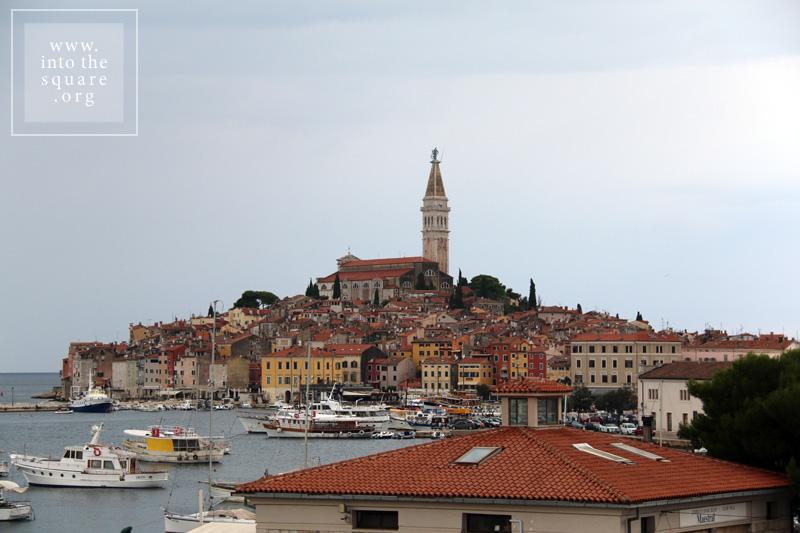
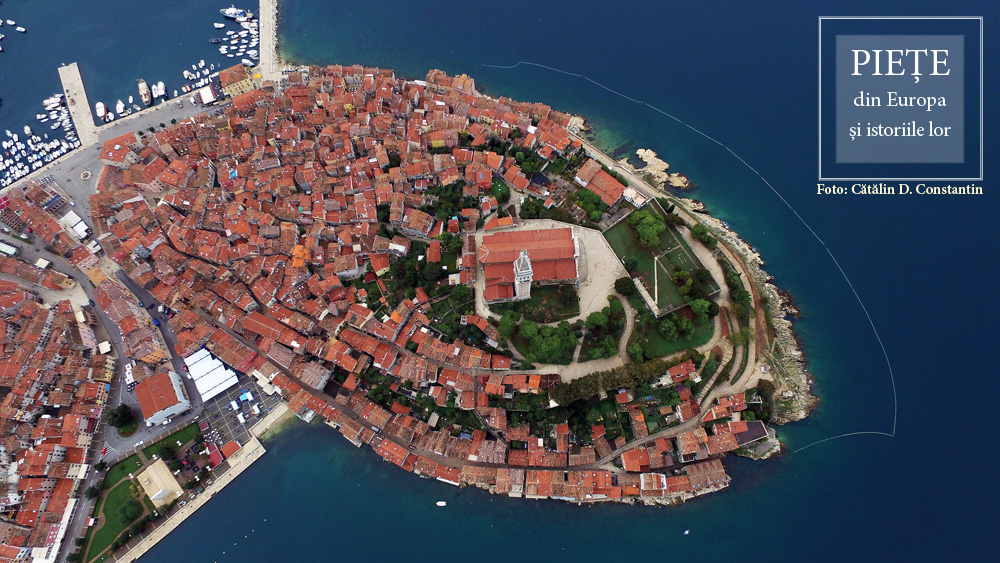
The history of this city is tied to Venice, but Rovinj was built much earlier, at the start of the 8th century, on an island separated from land by a narrow canal. Much later, in 1763, towards the end of Venetian rule, the community silts the isthmus and the city is united with the mainland. Through a classic process of synoecism, a new system of markets takes shape right on the spot of the old canal. They are four in number, and the most important is Trg G. Matteottija. Most of the buildings here are from the 19th century, but they celebrate the past link of the city with Venice, even recreating the lion of San Marco on the city hall’s pediment. The main square of the city remains Trg Sveta Eufemije, found at the highest point on the hill. Unobstructed on three sides, it gazes out to the sea, dominated by the 60 meter campanile of the basilica, with the statue of Saint Euphemia at the top, rotating in the breeze.